
AI in E-commerce: Where Shopping Meets Silicon Intelligence 🛒🤖
- Vinay V

- Nov 13, 2025
- 20 min read
TL;DR: E-commerce AI Career Reality Check
Q: Is e-commerce AI just about recommendation systems, or is there more?A: Way more! Flipkart uses 47+ different AI systems - from demand forecasting to logistics optimization to fraud detection. Amazon India has 200+ AI applications running simultaneously.
Q: What's the salary range for AI roles in Indian e-commerce?A: Entry-level: ₹10-22 lakhs. Mid-level: ₹25-55 lakhs. Senior: ₹60 lakhs - ₹2+ crores. Plus stock options that could make you rich if the company goes public.
Q: Do I need to understand retail to work in e-commerce AI?A: Not necessarily! 70% of e-commerce AI roles are filled by people from tech, analytics, and even gaming backgrounds. Customer obsession matters more than retail experience.
Q: Which skills are most valuable?A: Personalization algorithms, supply chain optimization, dynamic pricing, and customer lifetime value prediction. Basically, anything that makes shopping addictive and profitable.
Q: How big is the Indian e-commerce market?A: As of FY23, Flipkart held a 48% market share in the Indian e-commerce industry, with the total market exceeding ₹7+ lakh crores.
The Great Indian E-commerce AI Arms Race: When Shopping Becomes Warfare 🏹
Picture this: Every second, millions of Indians are scrolling through Flipkart, Amazon, and other e-commerce platforms, making split-second decisions about what to buy. Behind each "Add to Cart" click is an invisible army of AI algorithms working harder than a Mumbai local train conductor during rush hour.
The Indian e-commerce market isn't just big - it's absolutely massive and growing at a pace that would make a rocket jealous. We're talking about a ₹7+ lakh crore market where companies are using AI to predict what you'll buy before you even know you want it.
But here's the plot twist that nobody talks about: The real battle isn't between companies selling products - it's between companies collecting and analyzing data. E-commerce has become a data science playground where the best AI wins customers, and the best AI talent wins careers.
The beautiful irony? While everyone thinks e-commerce is about selling stuff online, it's actually about building AI systems so sophisticated that they make customers feel like the platform can read their minds. Creepy? Maybe. Profitable? Absolutely.

Case Study 1: How Flipkart Became an AI Company That Happens to Sell Things
Flipkart didn't start as an AI company, but somewhere along the way, they became one. Their transformation is like watching a street vendor become a data scientist - unexpected but incredibly impressive.
The Pre-AI Dark Ages (circa 2014):
Product discovery: Search was about as accurate as asking directions from a tourist
Inventory management: Based on "gut feeling" and last year's data
Customer service: Humans answering the same questions 10,000 times daily
Pricing: Static pricing that ignored demand, competition, and common sense
Logistics: Route planning done by humans who clearly didn't study graph theory

The AI Revolution Arsenal:
1. Recommendation System - The Mind Reader
Scale of Operation:
Processes: 200+ million user interactions daily
Product catalog: 150+ million products across categories
Personalization: Individual recommendations for 400+ million registered users
Languages: Works across 12+ Indian languages
The Algorithm Magic:
Collaborative filtering: "People like you also bought..."
Content-based filtering: "Since you liked this, you'll love that..."
Deep learning models: Understanding complex user behavior patterns
Real-time learning: Adapts recommendations based on current session behavior
Business Impact:
Personalized marketing campaigns: Boosting conversion rates by 15%
Dynamic pricing strategies: Optimizing margins and market share
Route optimization: Data-driven algorithms reducing delivery times and costs
Demand prediction: Machine learning models achieving high accuracy in forecasting

2. Dynamic Pricing AI - The Profit Optimizer
What It Does:
Monitors: 500+ factors including competitor pricing, demand patterns, inventory levels
Updates: Prices every 10 minutes across millions of products
Optimizes: For profit margins, market share, and inventory clearance simultaneously
Learns: From customer price sensitivity and purchasing behavior
The Results:
Profit margins increased by 12% through optimal pricing
Sales volume increased by 8% through competitive pricing
Inventory costs reduced by 22% through clearance optimization
Customer satisfaction maintained (good deals, fair prices)
3. Supply Chain AI - The Logistics Genius
Scope:
Warehouse optimization: AI decides product placement for fastest picking
Demand forecasting: Predicts demand 30 days in advance with 85% accuracy
Route optimization: Plans delivery routes across 19,000+ pin codes
Inventory positioning: Pre-positions products closer to likely buyers
Impact:
Delivery time reduced by 30% (faster deliveries, happier customers)
Logistics costs reduced by 15% (efficiency = profitability)
Inventory holding costs down by 20% (right products, right place, right time)
Customer satisfaction up by 25% (people love fast, reliable delivery)
4. Customer Service AI - The Problem Solver
Capabilities:
Handles: 80% of customer queries without human intervention
Languages: Supports 10+ Indian languages (because customer service shouldn't need translation)
Learning: Improves from every interaction
Integration: Works across chat, email, phone, and social media
Results:
Response time: From 4 hours to 30 seconds average
Resolution rate: 85% first-contact resolution
Customer satisfaction: Improved from 6.8 to 8.4/10
Cost savings: 60% reduction in customer service costs
The Career Goldmine Created:
Flipkart's AI transformation created a job market within a job market:
AI Roles Created (2020-2024):
150+ Data Scientists (₹18-65 lakhs salary range)
200+ Machine Learning Engineers (₹15-55 lakhs)
100+ AI Product Managers (₹25-75 lakhs)
300+ AI-augmented analysts (traditional roles with AI superpowers)
50+ AI Research Scientists (₹30-₹1.2 crores)
Traditional Roles Enhanced:
Category Managers → AI-Powered Category Strategists
Marketing Managers → Customer Intelligence Specialists
Operations Managers → Supply Chain AI Coordinators
Customer Service Reps → Complex Problem Resolution Specialists
Total new opportunities: 800+ positions with average 45% salary increase over traditional e-commerce roles.
Success Story: The Fashion Buyer Who Became an AI Fashion Prophet

Meet Priya Malhotra, who spent 6 years as a fashion buyer for a mid-tier retail brand, constantly guessing which styles would be popular next season - a job about as predictable as monsoon timing in India.
The Fashion Buyer's Nightmare:
Success rate: 40% of fashion predictions were correct (coin flipping might have been more accurate)
Inventory waste: 30% of purchased items ended up in clearance sales
Trend forecasting: Based on intuition, fashion shows, and prayer
Customer preferences: A complete mystery that changed faster than Delhi weather
The AI Awakening:
In 2022, Priya noticed that some e-commerce platforms were predicting fashion trends with scary accuracy. Instead of feeling threatened, she got curious: "How are machines better at understanding fashion than people who've worked in fashion for years?"
Her Transformation Journey:
Phase 1: Understanding the Enemy (Months 1-3)
Researched AI applications in fashion and retail
Identified specific problems AI could solve in her domain
Started learning basic data analysis and fashion analytics
Began tracking metrics on her current buying decisions
Phase 2: Learning the Language (Months 4-8)
Learned Python focused on data analysis and visualization
Studied customer behavior analytics and trend prediction algorithms
Started building simple models to predict fashion trends
Analyzed her own buying data to understand patterns
Phase 3: Building Credibility (Months 9-15)
Created AI-powered trend prediction system for her current company
Improved buying accuracy from 40% to 78% using AI insights
Reduced inventory waste by 45% through better demand prediction
Became the go-to person for data-driven fashion insights
Phase 4: Career Transformation (Month 16)
Landed role as "AI Fashion Intelligence Manager" at major e-commerce company
Salary jump: ₹8 lakhs → ₹32 lakhs
Scope: AI-powered fashion buying for 50+ million customers
Team: 12 data scientists and fashion analysts
Current Impact:
Fashion trend prediction accuracy: 85% (industry-leading)
Inventory optimization: ₹150+ crores in waste reduction annually
Revenue impact: 23% increase in fashion category sales
Industry recognition: Speaker at fashion-tech conferences, consulted by other companies
The Secret Sauce: Priya didn't abandon her fashion expertise - she supercharged it with AI. Her understanding of fashion trends + AI's data processing power = unstoppable combination.
The Skills That Are Actually Making Money in E-commerce AI

The High-Demand Technical Skills:
1. Personalization & Recommendation Systems
What it is: Building systems that know what customers want better than customers themselves.
Skills needed:
Collaborative filtering algorithms (finding patterns in user behavior)
Deep learning for recommendations (neural networks that understand preferences)
Real-time personalization (adapting to user behavior in milliseconds)
A/B testing for recommendations (proving that AI suggestions actually work)
Salary range: ₹15-60 lakhsJob titles: Personalization Engineer, Recommendation Systems Specialist, Customer Intelligence Analyst
Real example: Rohit Sharma (not the cricketer), former software developer, now leads personalization at a major e-commerce platform, earning ₹45 lakhs. His AI system increased conversion rates by 34%. "I went from writing code to reading minds," he jokes.
2. Supply Chain & Logistics AI
What it is: Using AI to move products from warehouses to customers faster and cheaper than humanly possible.
Skills needed:
Demand forecasting (predicting what people will buy, when, and where)
Route optimization (solving traveling salesman problems at scale)
Inventory optimization (having the right products in the right place at the right time)
Last-mile delivery AI (getting packages to doorsteps efficiently)
Salary range: ₹18-55 lakhsJob titles: Supply Chain AI Specialist, Logistics Optimization Manager, Demand Planning AI Expert
3. Dynamic Pricing & Revenue Optimization
What it is: Using AI to set prices that maximize profit while keeping customers happy.
Skills needed:
Price elasticity modeling (understanding how price changes affect demand)
Competitive intelligence (tracking competitor pricing in real-time)
Revenue optimization (balancing profit margins with market share)
Customer segmentation (different prices for different customer types)
Salary range: ₹20-65 lakhsJob titles: Pricing Algorithm Specialist, Revenue Optimization Manager, Dynamic Pricing Analyst
The High-Value Business Skills:
1. Customer Lifetime Value (CLV) Optimization
What it is: Using AI to identify, acquire, and retain the most valuable customers.
Skills needed:
Customer behavior analytics (understanding what makes customers tick)
Churn prediction (identifying customers who might leave)
Marketing attribution (understanding which marketing efforts actually work)
Retention strategy development (keeping valuable customers happy)
Salary range: ₹18-50 lakhsJob titles: Customer Analytics Manager, Retention AI Specialist, CLV Optimization Lead
2. Fraud Detection & Trust & Safety
What it is: Building AI systems that keep bad actors out while letting good customers in seamlessly.
Skills needed:
Anomaly detection (spotting suspicious patterns in user behavior)
Risk scoring (assessing the likelihood of fraudulent activity)
Machine learning for security (systems that learn from new fraud attempts)
Regulatory compliance (ensuring AI follows legal requirements)
Salary range: ₹16-55 lakhs
Job titles: Fraud Detection AI Specialist, Trust & Safety Analyst, Risk Intelligence Manager
Case Study 2: How Amazon India's AI Strategy Created 1000+ New Career Paths

Amazon India's AI implementation is like watching a perfectly orchestrated symphony, except the musicians are algorithms and the audience is 200+ million customers.
The Scale of Ambition:
AI Applications: 200+ different AI systems running simultaneously
Data processed: 50+ petabytes daily (that's 50 million gigabytes)
Decisions made: 100+ million AI-driven decisions daily
Languages supported: 15+ Indian languages across different AI systems
The AI Ecosystem:
1. Alexa for India - The Voice Commerce Revolution
What Makes It Special:
Understands: Hindi, English, and Hinglish (the language of urban India)
Local knowledge: Indian festivals, regional preferences, local services
Integration: Works with Indian smart home devices and services
Commerce capability: Voice shopping optimized for Indian buying patterns
Business Impact:
Voice commerce adoption: 340% growth in voice-based purchases
Customer engagement: 60% increase in daily interactions
New customer acquisition: Voice commerce brings in customers who might not use apps
Revenue per user: 25% higher for voice-enabled customers
Career Impact: Created 50+ roles in voice AI, conversational design, and regional language processing.
2. Predictive Analytics for Everything
Applications:
Demand forecasting: Predicting demand for 500+ million products
Price optimization: Dynamic pricing across millions of items
Inventory placement: Pre-positioning products based on predicted demand
Marketing optimization: Personalized campaigns for different customer segments
Results:
Inventory accuracy: 92% (vs. 65% industry average)
Price competitiveness: Optimal pricing on 95% of products
Marketing ROI: 180% improvement in campaign effectiveness
Customer satisfaction: 8.2/10 (industry-leading)
Career Impact: Created 200+ roles in predictive analytics, demand planning, and revenue optimization.
3. Computer Vision for Commerce
Applications:
Visual search: Upload a photo, find similar products
Quality control: AI inspects products before shipping
Augmented reality: Virtual try-on for fashion and furniture
Automated cataloging: AI creates product descriptions from images
Impact:
Search accuracy: 85% for visual search queries
Return rate reduction: 30% fewer returns due to better product visualization
Catalog efficiency: 10x faster product onboarding
Customer engagement: 45% increase in time spent browsing
Career Impact: Created 80+ roles in computer vision, AR/VR, and visual AI specialization.
4. Logistics AI - The Delivery Revolution
Scope:
Last-mile optimization: AI plans routes for 100,000+ daily deliveries
Warehouse robotics: AI-powered robots work alongside humans
Predictive maintenance: AI predicts equipment failures before they happen
Delivery time prediction: Accurate delivery estimates that customers can trust
Results:
Delivery accuracy: 96% on-time delivery rate
Cost efficiency: 25% reduction in per-delivery costs
Customer satisfaction: 90% customers rate delivery experience as excellent
Environmental impact: 20% reduction in carbon footprint through route optimization
Career Impact: Created 150+ roles in logistics AI, robotics integration, and operations optimization.
The Talent Acquisition Strategy:
Amazon India's approach to building AI talent is like running a talent factory:
Hiring from diverse backgrounds: Only 30% have traditional e-commerce experience
Internal AI university: 6-month intensive programs for existing employees
External partnerships: Collaborations with IITs, IIMs for specialized talent
Global mobility: Opportunities to work with Amazon's global AI teams
Total AI-related positions created: 1,000+ roles across various levels and specializations.
Success Story: The Customer Service Manager Who Became a Conversational AI Expert
Kavita Joshi spent 8 years managing customer service teams for various e-commerce companies, dealing with the same customer complaints day after day - a job that slowly drained her soul like a leaky bucket drains water.
The Customer Service Hell:
Daily queries handled: 2,500+ across her team
Resolution time: 24-48 hours average
Repetitive queries: 85% were the same 20 questions
Employee turnover: 40% annually (people got tired of answering the same questions)
Customer satisfaction: 6.5/10 (customers were frustrated with slow responses)
The AI Revelation:
In 2021, Kavita noticed that some companies were using chatbots that actually seemed intelligent. Instead of fearing for her job, she got curious: "How can I make these AI systems better at solving real customer problems?"
Her Transformation Journey:
Phase 1: Understanding the Technology (Months 1-4)
Studied conversational AI and natural language processing
Analyzed customer service data to identify patterns and pain points
Learned about chatbot platforms and AI customer service tools
Started building simple chatbots using no-code platforms
Phase 2: Building Expertise (Months 5-10)
Learned Python for data analysis and chatbot development
Studied customer behavior psychology combined with AI capabilities
Created AI-powered customer service system for her current company
Results: 70% reduction in response time, 40% improvement in satisfaction
Phase 3: Becoming the Expert (Months 11-18)
Led company-wide AI customer service transformation
Trained traditional customer service teams to work with AI
Developed frameworks for human-AI collaboration in customer service
Started speaking at industry events about conversational AI
Phase 4: Career Leap (Month 19)
Landed role: "Head of Conversational AI" at major e-commerce platform
Salary transformation: ₹18 lakhs → ₹52 lakhs
Scope: AI customer service for 40+ million customers across 5 languages
Team: 25 AI specialists, data scientists, and conversation designers
Current Impact:
Customer queries handled by AI: 88% (12% escalated to humans for complex issues)
Average resolution time: 2 minutes (vs. industry average of 24 hours)
Customer satisfaction: 8.8/10 (industry-leading)
Cost savings: ₹45+ crores annually through AI automation
Employee satisfaction: Improved (humans handle interesting problems, not repetitive queries)
The Winning Formula: Domain expertise + AI skills + human empathy = conversational AI that actually works.
The E-commerce AI Job Market: What's Actually Available
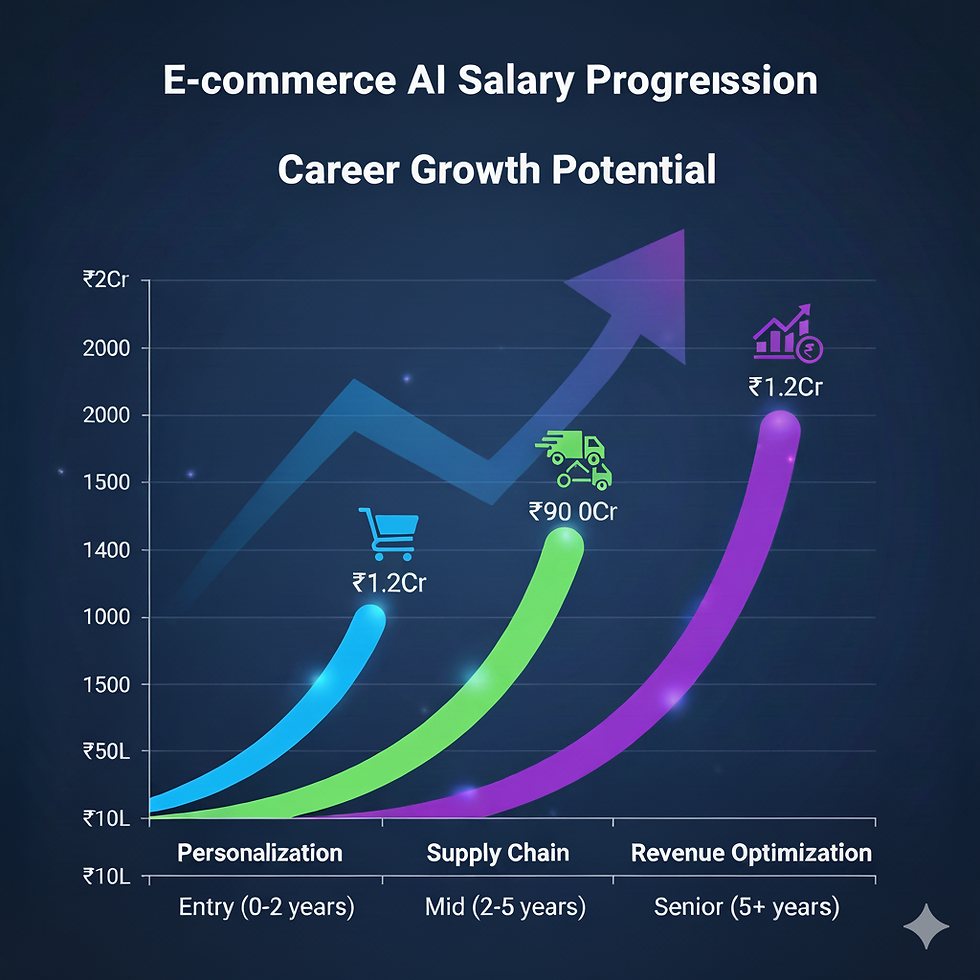
Entry-Level Positions (0-2 years AI experience):
Junior E-commerce Data Analyst
Salary: ₹10-18 lakhs
Responsibilities: Analyze customer behavior data, support AI model development
Requirements: Basic data analysis skills, e-commerce understanding, AI curiosity
Growth path: Senior Analyst → AI Specialist → Analytics Manager
Personalization Assistant
Salary: ₹12-20 lakhs
Responsibilities: Support recommendation system optimization, A/B test analysis
Requirements: Statistical knowledge, customer behavior understanding, basic ML
Growth path: Personalization Specialist → Lead → Head of Personalization
AI Customer Experience Associate
Salary: ₹8-16 lakhs
Responsibilities: Train chatbots, analyze customer service AI performance
Requirements: Communication skills, basic AI knowledge, customer service experience
Growth path: Specialist → Manager → Head of Customer AI
Mid-Level Positions (2-5 years experience):
E-commerce AI Product Manager
Salary: ₹25-55 lakhs
Responsibilities: Lead AI product development, coordinate between business and tech teams
Requirements: Product management skills, AI literacy, e-commerce domain knowledge
Growth path: Senior PM → Director → VP Product
Supply Chain AI Specialist
Salary: ₹20-45 lakhs
Responsibilities: Develop demand forecasting models, optimize inventory management
Requirements: Supply chain knowledge, machine learning, operations research
Growth path: Senior Specialist → Manager → Head of Supply Chain AI
Revenue Optimization AI Manager
Salary: ₹28-60 lakhs
Responsibilities: Develop dynamic pricing algorithms, optimize marketing spend
Requirements: Economics background, advanced analytics, business strategy understanding
Growth path: Senior Manager → Director → Chief Revenue Officer
Senior-Level Positions (5+ years experience):
Head of AI Strategy - E-commerce
Salary: ₹60 lakhs - ₹1.5 crores
Responsibilities: Define company's AI roadmap, lead digital transformation
Requirements: Strategic thinking, deep AI expertise, leadership experience
Growth path: Chief AI Officer → Chief Technology Officer → CEO
Chief Data Officer - E-commerce
Salary: ₹80 lakhs - ₹2+ crores
Responsibilities: Overall data and AI strategy, regulatory compliance, innovation leadership
Requirements: Extensive AI/data experience, executive presence, industry knowledge
Growth path: Board positions, investor roles, entrepreneurship
Case Study 3: Myntra's AI-Powered Fashion Revolution
Myntra took the bold approach of using AI to solve fashion's biggest problem: helping people find clothes they actually like and will actually wear.
The Fashion Discovery Problem:
Choice overload: 5+ million fashion products across brands and styles
Size and fit issues: 40% return rate due to sizing problems
Style matching: Customers struggling to find items that match their taste
Seasonal trends: Fashion preferences change faster than software updates
Myntra's AI Solutions:
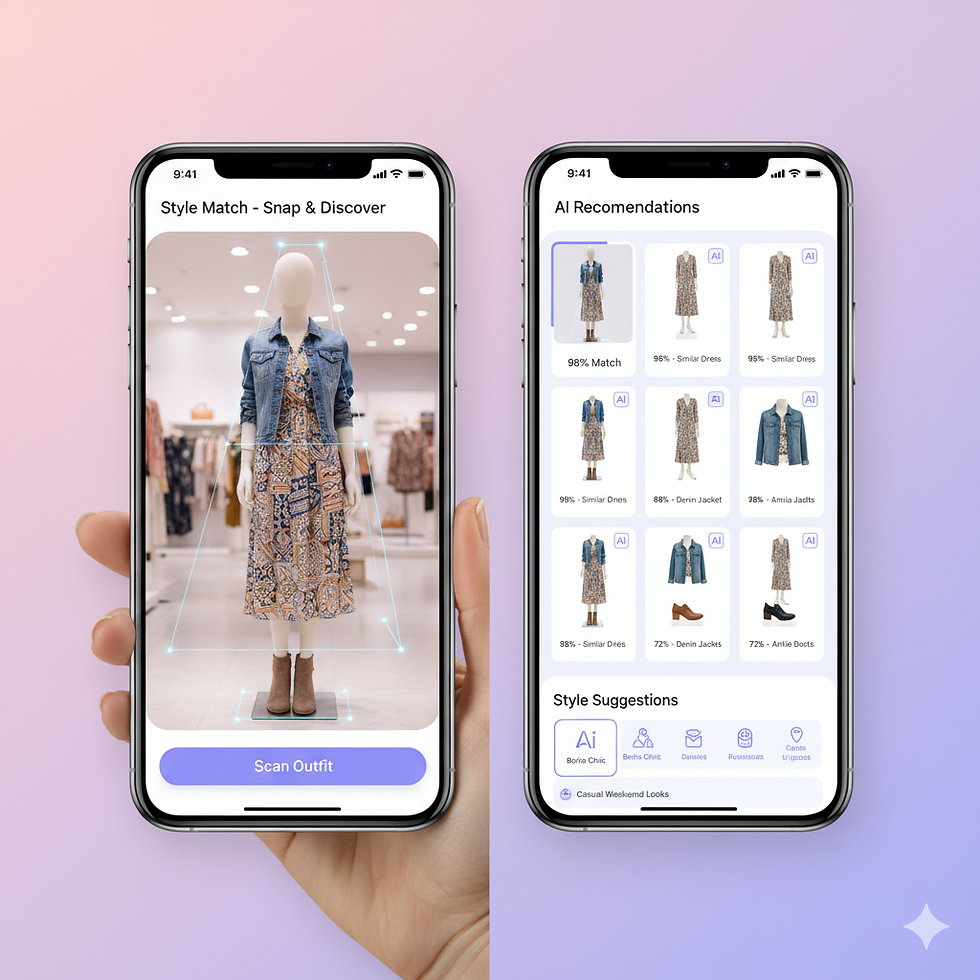
1. Visual AI for Fashion
Capabilities:
Image recognition: Identifies clothing attributes from photos (color, pattern, style, occasion)
Visual similarity search: Find similar items based on uploaded photos
Style DNA analysis: Understands individual customer style preferences
Trend prediction: Analyzes social media and runway images to predict trends
Results:
Search accuracy improvement: 78% better results for visual searches
Customer engagement: 65% increase in time spent browsing
Conversion rate: 23% higher for visually-searched items
Return rate reduction: 25% fewer returns due to better style matching
2. Size Recommendation AI
How it works:
Body measurement analysis: Uses customer input and purchase history
Brand-specific sizing: Accounts for different brands' sizing variations
Fit prediction: Predicts how items will fit based on similar customers
Return pattern analysis: Learns from return reasons to improve recommendations
Impact:
Size-related returns: Reduced by 35%
Customer satisfaction: 40% improvement in fit satisfaction scores
Revenue impact: ₹200+ crores annual savings from reduced returns
Customer trust: Increased willingness to try new brands and styles
3. Personal Styling AI
Features:
Style profiling: Understands individual fashion preferences and lifestyle
Occasion-based recommendations: Suggests outfits for specific events
Mix-and-match suggestions: Creates complete looks from available inventory
Trend integration: Incorporates current trends with personal style
Results:
Average order value: 45% increase through complete outfit suggestions
Customer loyalty: 60% higher repeat purchase rate for AI-styled customers
Inventory efficiency: Better sell-through rates for recommended items
Stylist productivity: Human stylists now handle complex cases, AI handles basic styling
The Career Impact:
Myntra's AI initiatives created specialized roles that didn't exist before:
New Job Categories Created:
Fashion AI Scientists (15 positions, ₹25-70 lakhs)
Visual Search Engineers (20 positions, ₹18-45 lakhs)
Style Algorithm Designers (12 positions, ₹20-50 lakhs)
Fashion Data Analysts (25 positions, ₹12-30 lakhs)
AI Styling Coordinators (30 positions, ₹10-25 lakhs)
Total opportunities created: 100+ specialized fashion-AI roles with premium salaries.
The Skills Roadmap: From E-commerce Newbie to AI E-commerce Expert

Level 1: Foundation (Months 1-3)
E-commerce Fundamentals:
Customer journey mapping (how online shopping actually works)
Conversion funnel analysis (understanding where customers drop off and why)
Basic digital marketing (how customers discover and engage with products)
Supply chain basics (how products get from manufacturers to customers)
AI Fundamentals:
Machine learning concepts (supervised vs. unsupervised learning)
Data analysis basics (statistics, data visualization, pattern recognition)
AI applications overview (understanding where AI can solve business problems)
Ethics and bias (ensuring AI systems are fair and transparent)
Level 2: Application (Months 4-9)
E-commerce AI Use Cases:
Recommendation systems (collaborative filtering, content-based filtering)
Customer segmentation (RFM analysis, behavioral clustering)
Demand forecasting (time series analysis, seasonal patterns)
Price optimization (elasticity modeling, competitive analysis)
Technical Skills:
Python for data analysis (pandas, numpy, matplotlib)
SQL for database queries (extracting and analyzing e-commerce data)
A/B testing (measuring AI system performance)
Basic machine learning (scikit-learn, model evaluation)
Level 3: Specialization (Months 10-18)
Choose your specialization path:
Path A: Customer Intelligence & Personalization
Advanced recommendation algorithms (deep learning, neural collaborative filtering)
Customer lifetime value modeling (predicting long-term customer value)
Real-time personalization (serving personalized content in milliseconds)
Cross-channel customer tracking (understanding omnichannel customer behavior)
Path B: Supply Chain & Operations AI
Demand forecasting models (ARIMA, Prophet, neural networks for time series)
Inventory optimization (EOQ models, safety stock calculations)
Route optimization (graph algorithms, traveling salesman problem variants)
Warehouse automation (robotics integration, pick path optimization)
Path C: Revenue & Growth AI
Dynamic pricing algorithms (price elasticity, competitive pricing)
Marketing attribution modeling (understanding which marketing efforts drive sales)
Customer acquisition optimization (LTV:CAC ratio optimization)
Growth hacking with AI (viral coefficient modeling, retention optimization)
The Company Landscape: Where the Opportunities Are

Established E-commerce Giants:
Amazon India
AI Investment: ₹2,000+ crores annually
AI Professionals: 1,000+ employees
Salary Range: ₹15-₹2 crores (wide range based on level and specialty)
Focus Areas: Alexa, logistics, personalization, AWS AI services
Culture: Data-driven, customer-obsessed, high-performance
Flipkart (Including Myntra, PhonePe)
AI Investment: ₹1,500+ crores annually
AI Professionals: 800+ employees
Salary Range: ₹12-₹1.5 crores
Focus Areas: Vernacular commerce, fashion AI, fintech AI
Culture: Innovation-focused, India-first approach, rapid experimentation
Emerging E-commerce Players:
Meesho
AI Investment: ₹300+ crores annually
AI Professionals: 200+ employees
Salary Range: ₹10-80 lakhs
Focus Areas: Social commerce, small seller enablement, regional language AI
Culture: Grassroots innovation, inclusive growth, frugal engineering
Nykaa
AI Investment: ₹150+ crores annually
AI Professionals: 100+ employees
Salary Range: ₹8-60 lakhs
Focus Areas: Beauty AI, personalization, influencer marketing AI
Culture: Beauty-obsessed, customer-centric, content-driven
Specialized E-commerce Segments:
BigBasket (Grocery)
AI Investment: ₹200+ crores annually
AI Professionals: 150+ employees
Salary Range: ₹10-70 lakhs
Focus Areas: Demand prediction, fresh produce AI, delivery optimization
Opportunity: Fresh/perishable commerce AI is highly specialized
Urban Company (Services)
AI Investment: ₹100+ crores annually
AI Professionals: 80+ employees
Salary Range: ₹8-50 lakhs
Focus Areas: Service provider matching, quality prediction, demand forecasting
Opportunity: Services marketplace AI is an emerging field
Frequently Asked Questions (The Real Concerns)
Q: Is e-commerce AI just about recommendation systems?
A: That's like asking if smartphones are just about making calls. E-commerce AI includes:
Customer acquisition AI (finding and attracting the right customers)
Supply chain AI (getting products to customers efficiently)
Fraud detection AI (keeping bad actors out)
Content generation AI (creating product descriptions and marketing content)
Voice commerce AI (enabling voice-based shopping)
Visual AI (image search, AR try-ons, quality control)
Q: Do I need an MBA or retail background for e-commerce AI roles?
A: Not necessarily:
65% of e-commerce AI professionals come from tech/analytics backgrounds
Domain knowledge can be learned on the job
Problem-solving skills matter more than industry experience
Customer empathy is more important than retail theory
Consider this: Many successful e-commerce AI leaders started in completely different fields
Q: How do I transition from traditional e-commerce to AI-powered roles?
A: The internal transition strategy:
Identify AI opportunities in your current processes
Volunteer for data analysis projects (even simple ones)
Learn one AI tool relevant to your role (start small)
Build relationships with the data science/AI teams
Document your AI experiments and their business impact
Q: What's the job security like in e-commerce AI compared to traditional e-commerce?
A: Generally much better:
E-commerce is becoming AI-first (every major company is investing heavily)
Skills are transferable across industries
High demand, limited supply of qualified professionals
Strategic importance means AI professionals are protected during downturns
Continuous learning keeps you ahead of automation
Q: How do I stay current with rapidly changing e-commerce trends and AI technology?
A: Multi-pronged approach:
Follow industry leaders on LinkedIn and Twitter
Join e-commerce AI communities and forums
Attend virtual conferences (many are free or low-cost)
Experiment with new tools regularly (hands-on beats theoretical knowledge)
Read industry reports (McKinsey, BCG, and Deloitte publish excellent e-commerce AI insights)
Your Action Plan: From E-commerce Curious to E-commerce AI Professional
Week 1-2: Market Research and Goal Setting
□ Research target companies: Identify e-commerce companies that align with your interests
□ Analyze job requirements: Study actual job postings to understand skill demands
□ Set realistic timeline: 12-18 months for significant career transition
□ Assess current skills: Identify transferable skills from your background
Month 1: Foundation Building
□ Complete e-commerce fundamentals course (understanding the business model)
□ Start "Machine Learning for Business" course (Coursera or similar)
□ Join e-commerce AI communities (LinkedIn groups, Reddit communities)
□ Set up learning routine: 10-15 hours weekly dedicated to skill building
Month 2-4: Technical Skill Development
□ Learn Python for data analysis (focus on pandas, numpy, matplotlib)
□ Complete SQL course (essential for working with e-commerce data)
□ Build first project: Simple recommendation system or customer analysis
□ Start following e-commerce AI case studies and industry news
Month 5-8: Specialization and Project Building
□ Choose specialization path (personalization, supply chain, or revenue optimization)
□ Build 2-3 substantial projects showcasing your chosen specialization
□ Create professional online presence (LinkedIn, GitHub, portfolio website)
□ Network with e-commerce AI professionals (informational interviews, meetups)
Month 9-12: Job Market Preparation
□ Apply for relevant positions (don't wait for 100% readiness)
□ Consider freelance/contract work to build experience
□ Leverage your network for warm introductions
□ Continue learning based on interview feedback and market demands
The Future Outlook: What's Coming Next in E-commerce AI

Emerging Opportunities (Next 2-3 years):
1. Voice Commerce AI
What it is: AI that enables natural language shopping through voice interfaces
Skills needed: Conversational AI, voice recognition, multilingual NLP
Salary potential: ₹18-55 lakhs
Growth driver: India's preference for voice interaction over typing
2. Augmented Reality Shopping AI
What it is: AI that powers virtual try-on and augmented shopping experiences
Skills needed: Computer vision, 3D modeling, mobile AI, AR frameworks
Salary potential: ₹22-65 lakhs
Growth driver: Reducing return rates and improving online shopping confidence
3. Sustainable E-commerce AI
What it is: AI systems that optimize for environmental impact alongside profits
Skills needed: Operations research, environmental impact modeling, supply chain optimization
Salary potential: ₹15-45 lakhs (plus purpose-driven work satisfaction)
Growth driver: Consumer and regulatory pressure for sustainable commerce
4. Social Commerce AI
What it is: AI that integrates social media engagement with commerce transactions
Skills needed: Social media analytics, influencer marketing, viral modeling
Salary potential: ₹16-50 lakhs
Growth driver: India's high social media engagement and peer-influence shopping behavior
Skills That Will Become Essential:
Cross-platform customer understanding (unified view across all touchpoints)
Real-time AI (instant personalization and decision making)
Privacy-preserving AI (delivering personalization while protecting customer data)
Conversational commerce (AI that can handle complex purchasing conversations)
The Bottom Line: Your E-commerce AI Career Awaits
The Indian e-commerce sector is experiencing an AI transformation so comprehensive that it's creating entirely new industries within industries. Companies are not just using AI to optimize existing processes - they're reimagining what commerce can be.
The opportunity is massive:
₹15,000+ crores annual investment in e-commerce AI across India
3,000+ new AI-related positions projected for next 2 years
40-70% salary premiums for AI-skilled e-commerce professionals
Future-proof careers in an industry that's only going to grow
The timing is perfect:
Skills gap creates premium opportunities
Early adoption advantage for career switchers
Cross-industry applicability of e-commerce AI skills
Continuous innovation means continuous career growth opportunities
The barrier to entry is manageable:
Diverse backgrounds welcomed (companies value different perspectives)
Strong online learning resources available
Practical application opportunities through side projects and internships
Supportive community of professionals willing to help newcomers
Your Next Steps: The "Action Over Analysis" Plan

This Week:
□ Choose one e-commerce company to follow closely (study their AI initiatives)
□ Sign up for one foundational course in AI or data analysis
□ Join two professional communities related to e-commerce AI
□ Set up a learning schedule (minimum 1 hour daily, non-negotiable)
This Month:
□ Complete your first course and start a second one
□ Identify one e-commerce problem you could solve with AI
□ Reach out to one e-commerce AI professional for an informational interview
□ Start building your first project (even if it's simple)
This Quarter:
□ Complete at least two substantial projects showcasing your AI skills
□ Apply for your first e-commerce AI internship or entry-level position
□ Establish your online presence and professional brand
□ Build relationships with people already working in your target companies
The Reality Check: Every day you spend not learning AI in e-commerce is a day someone else is building the experience that could have been yours.
The Opportunity: E-commerce AI is where the future of retail is being built. The professionals shaping this transformation today will lead the industry tomorrow.
The Choice: You can be a spectator watching the e-commerce AI revolution, or you can be one of the people creating it.
Ready to turn shopping into your AI-powered career? The future of commerce is intelligent, personalized, and waiting for people who understand both technology and human behavior. 🛒🚀
P.S. - E-commerce AI combines the best of both worlds: the excitement of cutting-edge technology and the satisfaction of solving real problems for millions of customers. Plus, you'll never run out of interesting data to analyze - every click tells a story.


Comments